Biomolecular general intelligence

From understanding lifeto curing disease.

We are an AI-native research team at the frontier of AI, biology, and medicine. We build foundation models for the life sciences to uncover biological mechanisms and drive the development of new medicines and therapies.

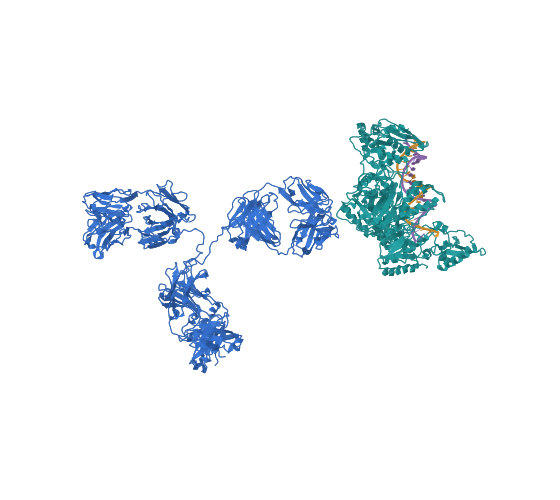
Sparse, soft particles assemble into an illustrative composite of a full Y-shaped antibody, a protein antigen and RNA–DNA, rotate, then disperse and repeat. This is a conceptual assembly, not an experimentally observed complex.

Research directions

Generative AI

We develop new theories for all-atom biomolecular modeling and next-generation multimodal generative models. Our foundation models unify structure prediction and molecular design across molecular types.

We predict and design interactions among proteins, nucleic acids, small molecules, and glycans. Diffusion language models unite sequence, structure, function, and cellular context to advance physical intelligence at the microscopic scale.
AI for protein design

We use biomolecular foundation models for controllable de novo protein design. Targeting peptide–HLA complexes (pHLA) and glycan antigens, we improve binding specificity and reduce cross-reactivity.

We design binding controlled by pH or small molecules, developing antibody, nanobody, cyclic peptide, and miniprotein therapeutics alongside recognition and control components for cellular immunotherapy.

AI for virtual cells

We combine single-cell multiomics, perturbation data, and predicted complex structures to build virtual cell foundation models of the immune system. Molecular structure and interactions are integral dimensions of cell modeling.

We link molecular mechanisms to cell states to predict intervention responses, identify candidate targets for cellular immunotherapy, and explore patient stratification and treatment response prediction, providing testable insights for precision therapy.

AI agents connecting drug discovery and development

We build AI agents that reason about biology, coordinate models and tools, and plan experiments across target discovery, drug design, and delivery. Wet-lab feedback tests predictions, updates hypotheses, and refines candidates, linking discovery, design, and validation in a continuous learning cycle.

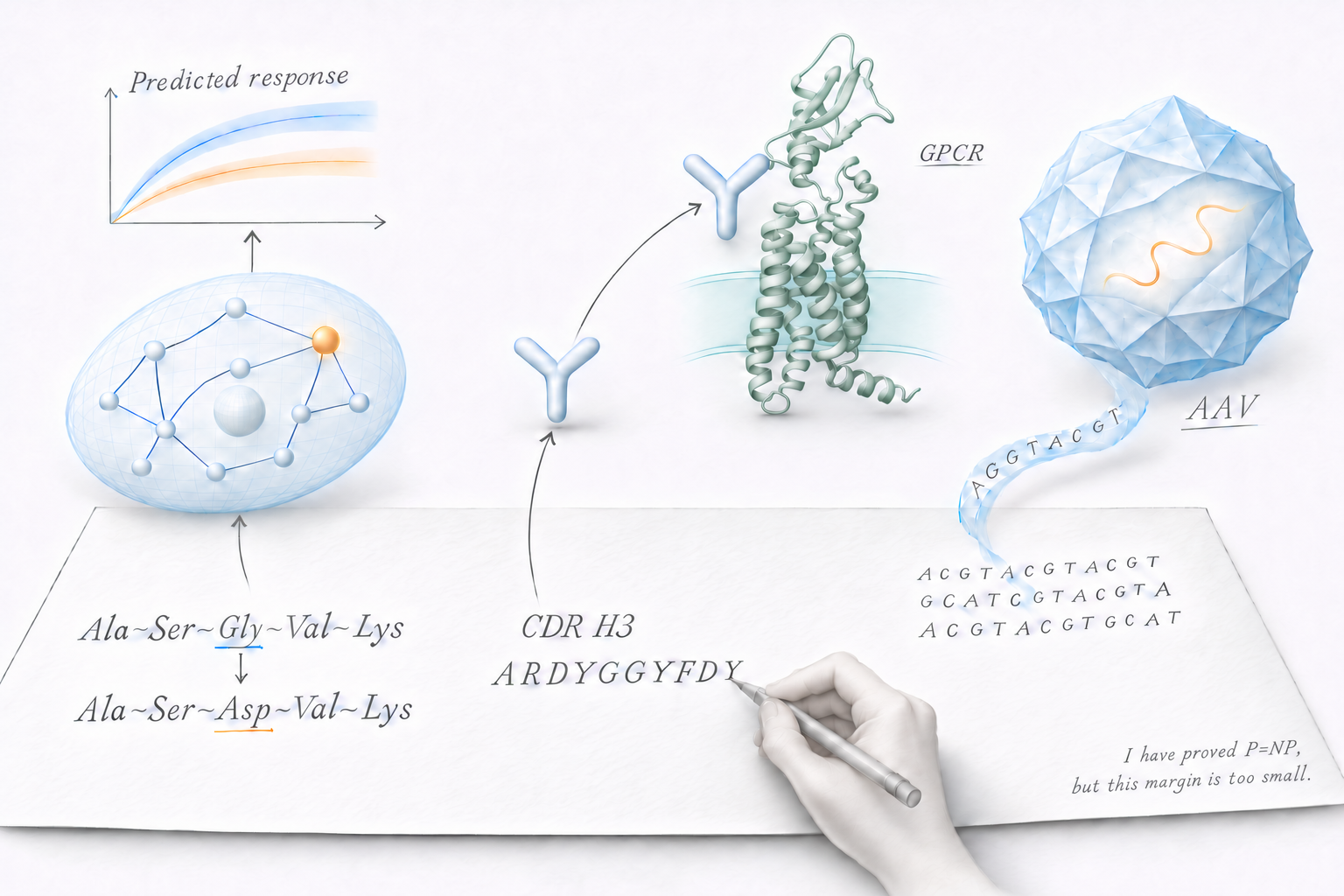
A pencil-sketch concept illustration: a hypothetical Gly-to-Asp substitution feeds into a virtual cell and predicted responses. Two arrows lead from a handwritten CDR H3 sequence to a generated Y-shaped antibody, then to an antibody binding the extracellular region of a membrane-embedded GPCR. DNA letters lead to an AAV capsid carrying single-stranded DNA. The sequences and structures are illustrative. A playful margin note reads: “I have proved P=NP, but this margin is too small.”
  1. Target discovery

  2. Drug design

  3. Drug delivery

  4. Wet-lab feedback

Every experiment informs the next design

Research concept

Enlarge to explore the details, then swipe or scroll within the image.

A pencil-sketch concept illustration: a hypothetical Gly-to-Asp substitution feeds into a virtual cell and predicted responses. Two arrows lead from a handwritten CDR H3 sequence to a generated Y-shaped antibody, then to an antibody binding the extracellular region of a membrane-embedded GPCR. DNA letters lead to an AAV capsid carrying single-stranded DNA. The sequences and structures are illustrative. A playful margin note reads: “I have proved P=NP, but this margin is too small.”

Selected work

All publications

Understanding function

Precision generation

Physical alignment

Join us

Help shape the next chapter.

We welcome students, visiting researchers, and postdoctoral fellows who want to work across AI, biology, and medicine. Bring your curiosity and build with us.